What is the UL 2167A standard?
UL 2167A is UL’s Outline of Investigation for Targeting Water Mist System Units for One- and Two-Family Dwellings for Fire Protection Service.
It establishes requirements for wall-mounted, targeted water mist system units intended to control fires in one- and two-family dwellings and manufactured homes, providing improved protection against injury and life loss (Section 1.1).
Systems covered by UL 2167A are intended to be installed in accordance with NFPA 750 (Section 1.3).
The full standard is available to view or purchase from the UL standards shop.
What types of systems does UL 2167A cover?
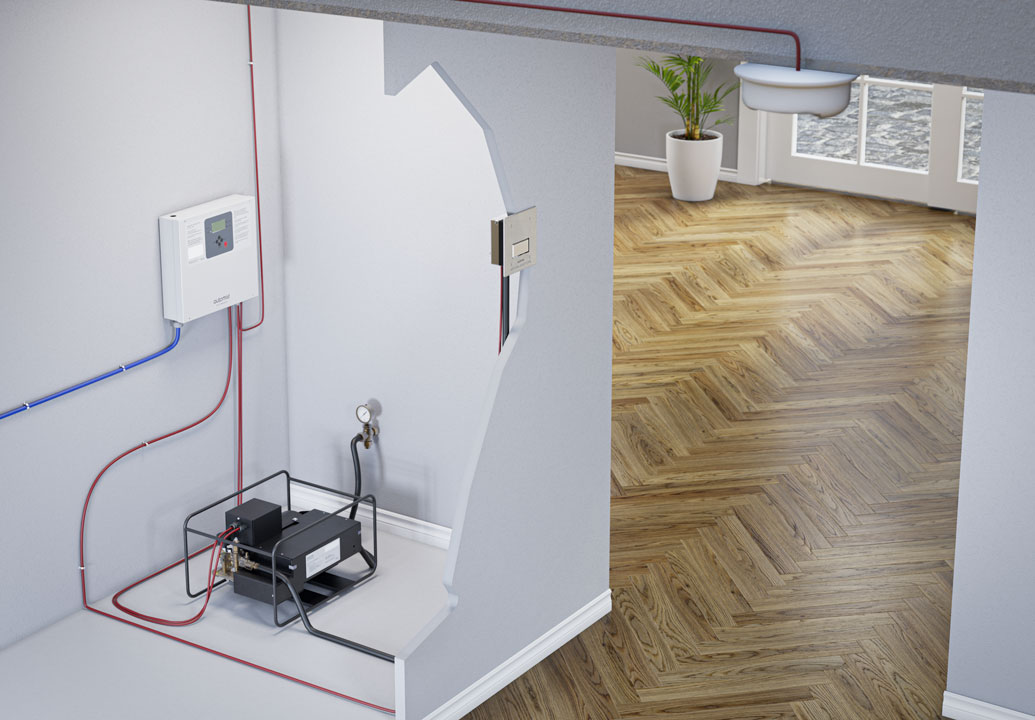
UL 2167A applies to integrated system units consisting of detection, control, and water discharge components. The standard explicitly requires:
- Targeted spray nozzles complying with UL 2167 (Section 7.1, 18.1)
- Smoke detection complying with UL 268 (Section 10.1, 14.1)
- System controls and releasing functions complying with UL 985 and UL 864 (Section 9.2, 9.4, 19.1)
- Pump and motor assemblies meeting UL requirements (Sections 12, 13, 20)
- Valves, strainers, and piping components meeting UL fire protection standards (Sections 8, 11, 15–17)
These requirements demonstrate that UL 2167A covers a detection-initiated, electrically controlled fire protection system.
How is performance evaluated under UL 2167A?
Fire test program
UL 2167A requires full-scale fire testing of the complete system unit (Section 23).
The system must be evaluated across 17 defined fire tests (Section 23.2.1, Table 23.1), including:
- Upholstered furniture fires (fabricated sofa)
- Residential fuel package fires (per UL 2167)
- Fires with obstructions near the nozzle and fuel package (Tests 10–13)
- Cooking oil fires (Tests 8 and 9)
- Both small-room and large-room configurations (Sections 23.4.1, Figures 23.15–23.16)
- Cooking fire testing requires:
- A residential cooktop ignition source
- Canola oil (or equivalent) heated to autoignition (Section 23.3.3.2, 23.3.3.7)
Performance criteria
During fire testing, the system must limit thermal conditions within the compartment.
UL 2167A defines maximum allowable temperatures (Section 23.1.1):
- Ceiling gas temperature ≤ 600°F (316°C) (23.1.1(a))
- Occupant height (1.6 m) ≤ 200°F (93°C) at more than one location (23.1.1(b))
- Limited duration above 130°F (54°C) at occupant level (23.1.1(c))
- Ceiling material temperature ≤ 500°F (260°C) (23.1.1(d))
Additional requirements:
- Testing must use the minimum design pressure (Section 23.1.2)
- Water delivery delay must be accounted for (Section 23.1.3)
- Temperatures must be instrumented and continuously recorded (Section 23.5.2)
How does UL 2167A address system reliability?
UL 2167A includes mechanical, hydraulic, and environmental durability requirements:
Hydraulic and pressure performance
- Pumps must deliver required flow and pressure (Section 20.1)
- Systems must withstand hydrostatic pressure without leakage or rupture (Section 21.1–21.2)
Endurance testing
- Pumps must operate for 24 hours at rated conditions (Section 20.2)
Environmental durability
Polymeric components must withstand:
- Air-oven aging (180 days at 100°C) (Section 22.1)
- Water immersion aging (180 days at 87°C) (Section 22.2)
- Components must remain functional after aging (Sections 22.1, 22.2)
Functional system testing
- Control and releasing systems must meet UL fire alarm standards (Section 19.1)
System operation during testing includes recording:
- Detector activation
- Pump operation
- Nozzle discharge timing (Section 23.3.3.8)
How are nozzles and water delivery evaluated?
UL 2167A requires the targeting spray nozzle to comply with:
- UL 2167 (Water Mist Nozzles for Fire Protection Service) (Sections 7.1, 18.1)
This ensures nozzle discharge performance is evaluated under established UL water mist test methods.
What does UL 2167A certification demonstrate to AHJs?
Certification to UL 2167A demonstrates that the system:
- Is evaluated as a complete, integrated system unit (Sections 7–13, 19–23)
- Is intended for one- and two-family dwellings and manufactured homes (Section 1.1)
- Provides supplemental fire protection only (Section 1.2)
- Is installed in accordance with NFPA 750 (Section 1.3)
- Has been tested under multiple residential fire scenarios, including cooking fires (Section 23.2, Table 23.1)
- Meets defined thermal performance limits during fire exposure (Section 23.1.1)
- Has passed hydraulic, endurance, and environmental durability testing (Sections 20–22)
You can confirm Automist’s UL Listing under File Number EX29276 on the UL Product iQ database.
For additional documentation, including UL certification details and fire test reports, contact Plumis or refer to our Automist UL System Certificate.
Disclaimer: This information is not intended to be a comprehensive guide to all of the aspects of the building/fire code but rather a useful source of background information. Whilst every care has been taken to ensure that the contents of this post are correct at the time of publication, it should never be used as any form of substitution for the full NFPA® codes, standards, recommended practices, and guides. It should be noted that there may be specific additional requirements dependent upon the Authority Having Jurisidiction (AHJ).
Yes. Automist can be used as an alternative to an NFPA 13D fire sprinkler system in one- and two-family dwellings, where permitted by the local Authority Having Jurisdiction (AHJ). Automist is a UL 2167A Listed water mist fire suppression system, designed and installed in accordance with NFPA 750 and the manufacturer’s Design, Installation, Operation and Maintenance Manual (DIOM).
Learn moreAutomist is UL-listed under UL 2167A, certifying it as a residential water mist fire suppression system in line with NFPA 750, with proven performance, safety, and reliability through rigorous independent testing. This certification is widely recognized by regulators and insurers, and can be verified under File Number EX29276 on the UL Product iQ database.
Learn more