Automist vs. traditional sprinklers: What’s best for ADUs?
Does your ADU require a fire sprinkler system?
It depends on where you build and whether your primary home is already sprinklered. Two states mandate sprinklers in all new one- and two-family dwellings at the state level: California (CRC §R313.2, effective 1 January 2011) and Maryland (effective 1 July 2015 for one- and two-family homes). Elsewhere, the trigger comes from the locally adopted building code (usually IRC §R313) or from a municipal ordinance.
Most states treat an ADU as a new dwelling unit, which means the same sprinkler rule that applies to a new house applies to the ADU. Several states have written explicit ADU carve-outs to avoid making new units uneconomic to build:
- California — Gov Code §65852.2(a)(1)(D)(xii):
“Accessory dwelling units shall not be required to provide fire sprinklers if they are not required for the primary residence. The construction of an accessory dwelling unit shall not trigger a requirement for fire sprinklers to be installed in the existing primary dwelling.” - Oregon — ORS 197.312(5) limits local sprinkler requirements on ADUs beyond what state code already requires.
- Washington — RCW 36.70A.681 restricts local governments from imposing ADU requirements, including sprinklers, that are stricter than the state building code.
Local ordinances, designated wildland-urban interface zones (California’s VHFHSZ, Colorado’s WUI maps, Oregon’s SB 762 designations), and ADUs above certain size thresholds can still trigger a requirement even where a state exemption exists.
When the trigger applies, you have two compliant paths:
- A traditional fire sprinkler system to NFPA 13D, which is referenced in the IRC and adopted in all 50 states
- Automist, a UL Listed targeted water mist system, installed as an alternative under IFC §904.11 (adopted in most states, including California as CFC §904.11)
Both control fire in the room of origin long enough for occupants to escape. What they demand from the building is very different.
Installation
Traditional fire sprinklers use rigid plastic or metal pipes installed in ceilings and walls, with sprinkler heads in every room. In modular homes, this can mean opening up ceilings, coordinating multiple trades, and repairing finishes afterwards on site.
Automist uses small spray heads mounted on the wall (in a shallow 50 mm box, about 1.2–1.3 m above the floor). These connect by flexible hose to a compact pump (around 9″ × 7″ × 14″) that fits under a sink. No ceiling pipework is needed.
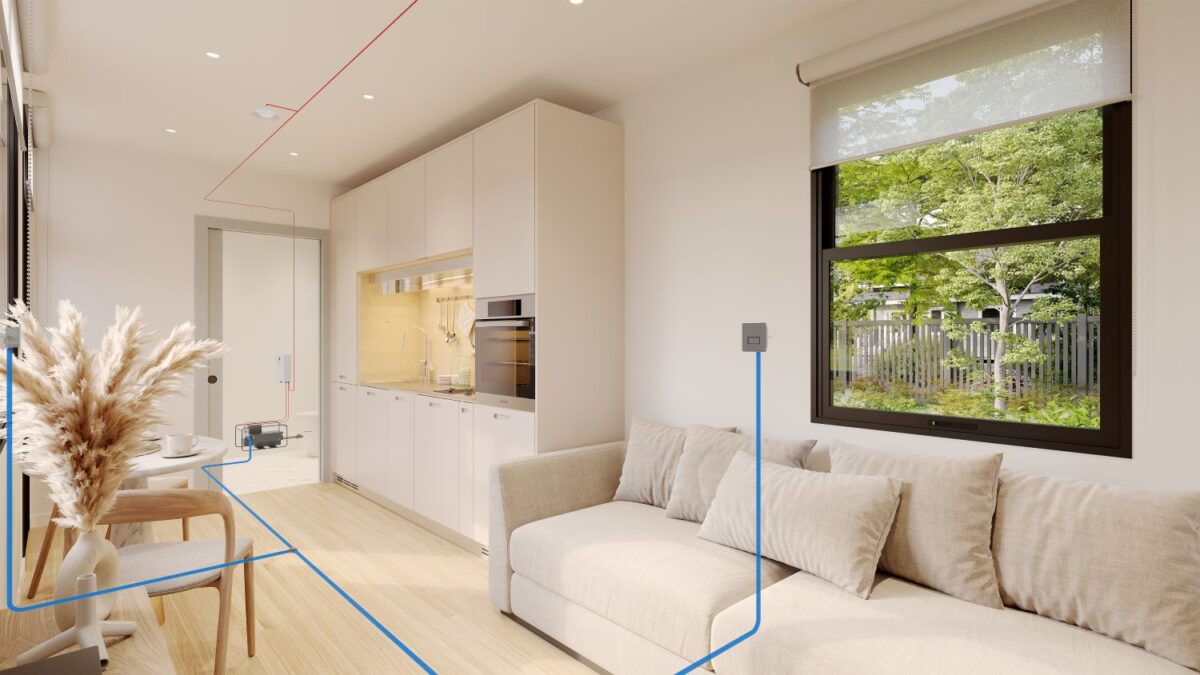
Flexible hose is much easier to install than rigid pipe. It can bend around obstacles and follow existing spaces in the wall, without needing straight runs. For modular homes, this means more work can be completed in the factory, with final connections made on site. The system is then pressure tested to confirm performance.
Water supply
A typical residential sprinkler requires around 13 gpm at 7 psi, resulting in a standard two-head demand of ~26 gpm.
Many jurisdictions add domestic demand on top. For example, California adds a flat 5 gpm, and features like sloped ceilings, beams, or sidewall sprinklers can push total demand higher.
A standard 5/8″ residential water meter cannot reliably deliver this flow, so most homes require a 1″ or larger meter upgrade.
Typical costs:
- Meter upgrade (tap fee): $2,000 to $15,000
- Service line replacement: $10,000 to $30,000, depending on distance, depth, and roadwork
In Los Angeles, street restoration requirements (LAMC §62.06) often push costs toward the higher end.
Automist uses just 2.37 gpm (9 L/min) and connects directly to a standard 3/4″ domestic cold water line.
No meter upgrade. No new tap. No tank.
Download our “Compare Automist to Fire Sprinklers” PDF.
Activation
Traditional sprinklers rely on heat activation. Each head contains a glass bulb that must reach a set temperature before it opens.
Automist uses a ceiling mounted smoke detector and then a wall mounted infrared sensor to detect and locate a fire early, then directs water mist at the source.
Independent testing published in the Fire Safety Journal (April 2022) found Automist activates 2 to 14 times faster than concealed residential sprinklers, because it does not need to wait for heat to build at the ceiling.
Automist is also a dry system until activation, while traditional 13D systems are typically wet, with water sitting in ceiling pipework at all times. It therefore avoids common causes of accidental damage associated with wet sprinkler systems:
- leaks from aging pipework
- freeze-related pipe bursts in unheated spaces
- seismic damage to pipework (particularly relevant in earthquake-prone regions)
A typical two-head sprinkler discharge (12 gpm per head) running for the 10-minute minimum required by NFPA 13D releases around 240 gallons of water into the home.
Automist, by comparison, uses 2.37 gpm, or approximately 24 gallons over the same period.
That is roughly a 90% reduction in water use, delivered as a targeted high-pressure mist rather than falling from above. This significantly reduces spread into adjoining rooms, floors, and contents.
Disclaimer: This information is not intended to be a comprehensive guide to all of the aspects of the building/fire code but rather a useful source of background information. Whilst every care has been taken to ensure that the contents of this post are correct at the time of publication, it should never be used as any form of substitution for the full NFPA® codes, standards, recommended practices, and guides. It should be noted that there may be specific additional requirements dependent upon the Authority Having Jurisidiction (AHJ).
Yes. Automist can be used as an alternative to an NFPA 13D fire sprinkler system in one- and two-family dwellings, where permitted by the local Authority Having Jurisdiction (AHJ). Automist is a UL 2167A Listed water mist fire suppression system, designed and installed in accordance with NFPA 750 and the manufacturer’s Design, Installation, Operation and Maintenance Manual (DIOM).
Learn moreTo ensure your Automist system is installed correctly and complies with all necessary standards, it must be fitted by a trained installer. In the US, we recommend choosing from our network of trained installers who are familiar with the system’s unique design and requirements. You can find our official list of approved installers here.
This ensures you receive a professional installation and the peace of mind that your Automist system will perform as intended.
Learn moreTraditional fire sprinkler quotes often exclude the cost of upgrading your water supply, which is why total costs can increase significantly. While the sprinkler system itself may cost as little as $5,000–$6,000, water utilities may require a larger meter to meet the system’s flow demand, adding both upfront installation fees and possible ongoing monthly charges. Depending on the property and infrastructure, these additional costs can range from a few thousand dollars to much higher in complex cases. Automist operates at significantly lower flow than conventional sprinklers – a standard domestic meter can handle the demand without upsizing.
Learn more