Can Automist be used with sprinklers in homes with complex ceilings?
Yes, subject to approval by the local Authority Having Jurisdiction (AHJ). A single family dwelling may be designed with conventional NFPA 13D sprinklers in straightforward areas and a separate Automist system protecting selected rooms where intricate ceiling geometry makes traditional sprinkler installation more challenging.
Depending on the AHJ, the proposal may require an Alternative Materials and Methods Request (AMMR) demonstrating that the combined approach provides an equivalent level of fire and life safety.
This should be presented as a coordinated fire suppression design, not as one mixed NFPA 13D system. The sprinkler portion and Automist portion each have their own design, installation and approval requirements.
Why can complex ceilings make residential sprinklers more difficult?
Residential sprinklers are normally installed close to the ceiling and must distribute water without significant obstructions. Ceiling shape and architectural details can therefore affect sprinkler position, spacing and coverage.
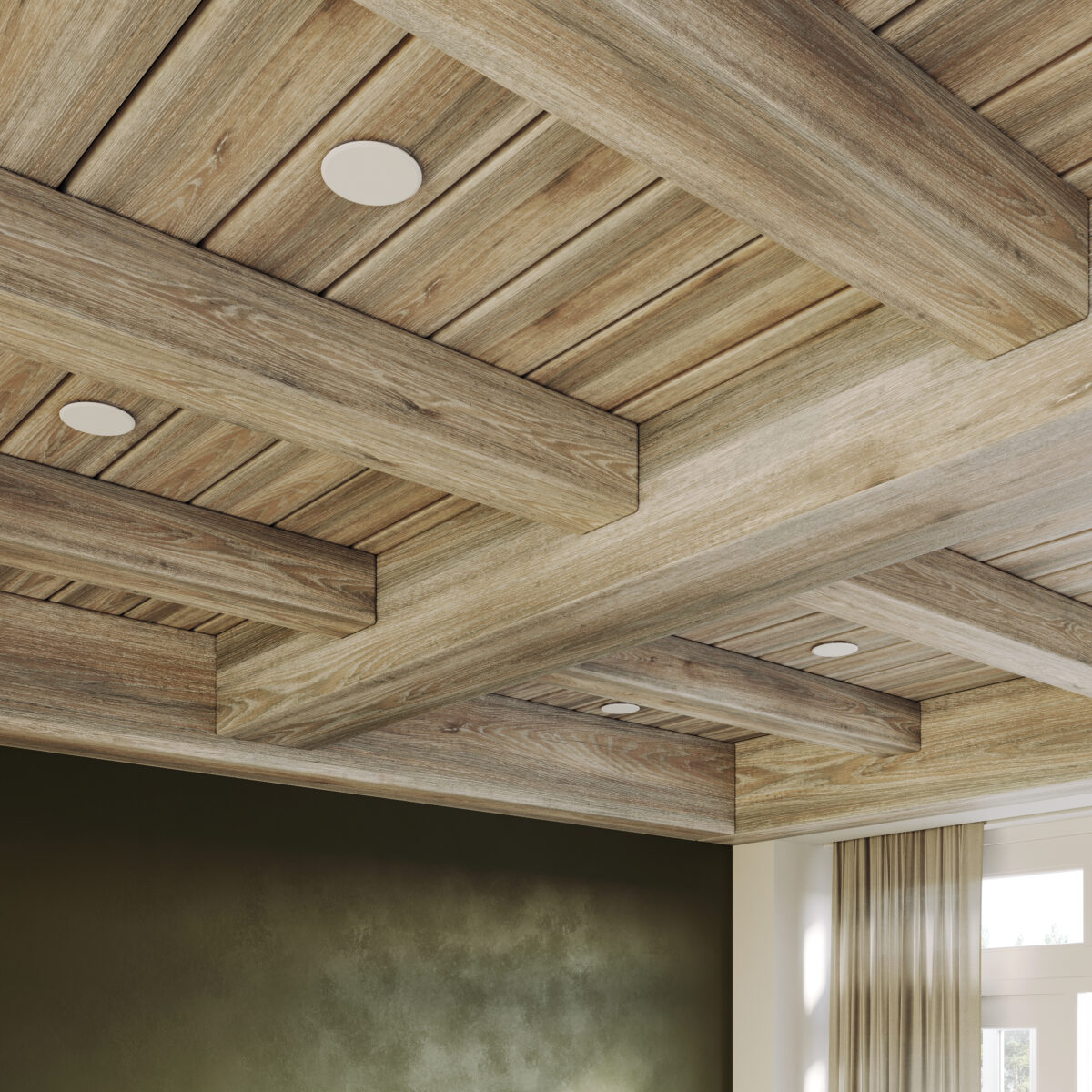
Potentially challenging features include:
- barrel vaulted ceilings
- domed plaster ceilings
- exposed terracotta planks
- large or crisscrossing beams
- intricate coffered ceilings
- multiple intersecting ceiling planes
These features do not necessarily prevent the use of sprinklers. However, beams, ceiling offsets and decorative elements can obstruct their discharge pattern. Depending on the sprinkler’s listing and the room geometry, additional sprinkler heads or specialized layouts may be necessary. Sloped and beamed ceilings can also affect the number of sprinklers included in the hydraulic design, as explained in current residential sprinkler design guidance.
How can Automist help?
Automist spray heads are mounted on the wall at approximately light switch height rather than in the ceiling. Following smoke detection, the spray heads scan the room, identify the fire’s location and direct high pressure water mist toward it.
This wall mounted approach can preserve decorative ceilings and avoid having to position conventional sprinkler heads around every beam, pocket or intersecting ceiling plane. It can be particularly useful when most of the home is straightforward to protect with NFPA 13D sprinklers but one or two architecturally important rooms create significant design challenges.
What approval and design requirements apply?
The complete suppression strategy should be agreed with the AHJ during plan review and before either system is installed.
The conventional sprinkler portion should be designed and installed in accordance with NFPA 13D and the listings of the selected sprinklers. Automist is UL Listed to UL 2167A and is intended for installation in one and two family dwellings under the applicable provisions of NFPA 750, as described by UL Solutions.
The AHJ may require a formal AMMR to approve Automist for the selected areas as an alternative to the prescriptive sprinkler design. The submission may need to include the proposed system boundaries, reflected ceiling plans, Automist working plans, product listing information, fire test evidence and an explanation of how the design provides equivalent protection. Requirements and terminology vary between jurisdictions, so the approval process should be confirmed with the AHJ at the beginning of the project.
The plans should clearly identify which system protects each required area. Open plan rooms, doorways and transitions between the two systems require particular coordination so that there are no gaps in coverage.
Are there ceiling height restrictions?
Automist’s current UL 2167A listing is based on fire testing with ceiling heights up to 8 ft. However, additional testing conducted by the Baltic Fire Laboratory evaluated Automist in a room with an 18 ft ceiling.
In its July 2026 Fire Test Judgement Report, Jensen Hughes concluded that the 18 ft testing was comparable to the applicable UL fire testing and demonstrated that Automist was capable of meeting the intent of NFPA 750 by preventing flashover and improving occupants’ ability to escape or be evacuated.
When is a combined approach worth considering?
A combined design can be worth exploring when conventional sprinklers are suitable for most of a home, while selected rooms have complex ceilings, exposed finishes or important architectural details.
The architect, sprinkler designer, trained Automist designer and AHJ should coordinate early in the project. This makes it possible to confirm ceiling heights, system boundaries, water supplies, AMMR documentation and approval requirements before the architectural design is finalized.
Disclaimer: This information is not intended to be a comprehensive guide to all of the aspects of the building/fire code but rather a useful source of background information. Whilst every care has been taken to ensure that the contents of this post are correct at the time of publication, it should never be used as any form of substitution for the full NFPA® codes, standards, recommended practices, and guides. It should be noted that there may be specific additional requirements dependent upon the Authority Having Jurisidiction (AHJ).
Yes. Automist can be used as an alternative to an NFPA 13D fire sprinkler system in one- and two-family dwellings, where permitted by the local Authority Having Jurisdiction (AHJ). Automist is a UL 2167A Listed water mist fire suppression system, designed and installed in accordance with NFPA 750 and the manufacturer’s Design, Installation, Operation and Maintenance Manual (DIOM).
Learn moreYes, Automist can provide whole-house fire protection in compliance with NFPA 750, which governs water mist fire suppression systems for one- and two-family dwellings. It is designed to be a room-based solution, meaning multiple spray heads can be strategically installed throughout the home to ensure full coverage.
Learn morePossibly. While insurance discounts or “policy credits” are determined on a case-by-case basis, Automist has already been used successfully to secure coverage and lower premiums for high-value homes — especially in wildfire-prone areas and PPC 10 risk classifications where traditional coverage is increasingly difficult to obtain.
As insurers tighten underwriting criteria due to rising wildfire risk and water damage claims, automatic discounts for standard fire suppression systems are becoming less common. However, Automist stands out as an innovative loss mitigation solution — not only by reducing fire damage, but also by minimizing the risk of excessive water damage, which is a major cost concern for insurers.
Learn more